
Poster for The Society for the Neuroscience of Creativity
Updated: Jun 8
Thank you to The Society for the Neuroscience of Creativity for inviting me to submit a poster presentation to this year's conference in Philadelphia. SfNC has member researchers from 34 countries, and it was exciting to be one of the artists, musicians, and performers, and architects included in the conversation.
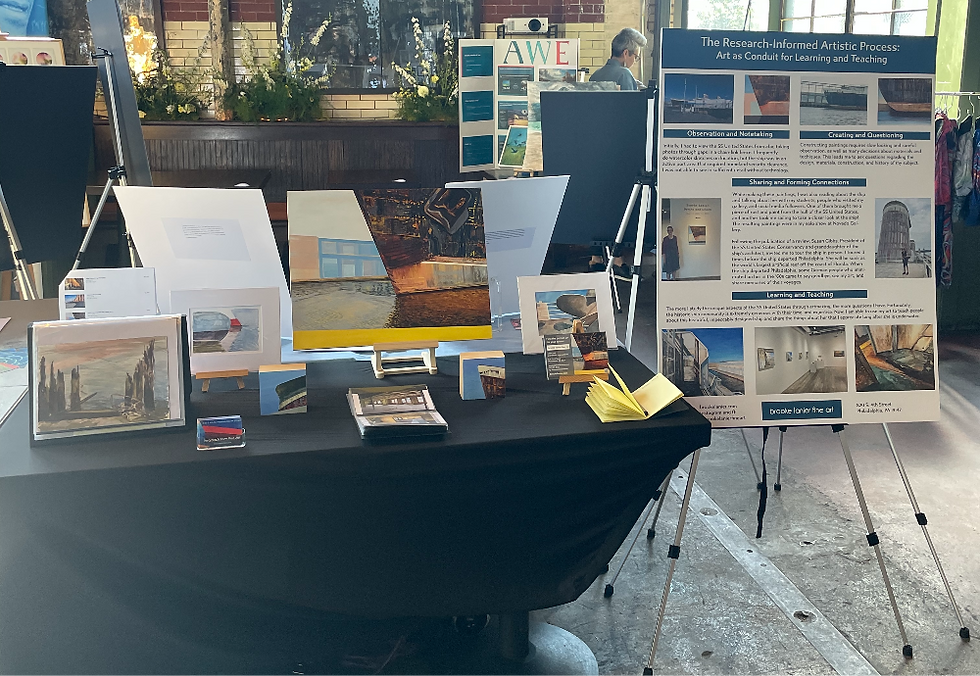
I presented this poster alongside original paintings and a flip book of source photos I took while touring the ship. You can click the image below to enlarge it. For more information about how I became interested in the historic ships of the Delaware River, you can visit my Historic Ship Preservation Blog.
See more of the paintings and ceramic sculptures of the SS United States.
If you'd like to see my art in person, you are welcome stop by between 11-5 on Fridays and Saturdays or schedule an appointment.

Observation and Notetaking
Initially, I had to view the SS United States from afar, taking photos through gaps in a chain-link fence. I frequently do watercolor sketches on location, but the ship was in an active port area that required homeland security clearance. I was not able to see in sufficient detail without technology.
Creating and Questioning
Constructing paintings requires slow looking and careful observation, as well as many decisions about materials and techiques. This leads me to ask questions regarding the design, materials, construction, and history of my subject.
Sharing and Forming Connections
While making these paintings, I was also reading about the ship and talking about her with my students, people who visited my gallery, and social media followers. One of them brought me a piece of rust and paint from the hull of the SS United States, and another took me sailing to take a closer look at the ship! The resulting paintings were in my solo show at Novado Gallery.
Following the publication of a review, Susan Gibbs, President of the SS United States Conservancy and granddaughter of the ship’s architect, invited me to tour the ship in person. I toured 3 times before the ship departed Philadelphia. She will be sunk as
the world’s largest artificial reef off the coast of Florida. When the ship departed Philadelphia, some German people who immigrated on her in the ‘60s came to say goodbye, see my art, and share memories of their voyages.
Learning and Teaching
The more I study the unique aspects of the SS United States through artmaking, the more questions I have. Fortunately, the historic ship community is extremely generous with their time and expertise. Now, I am able to use my art to teach people about this beautiful, impeccably designed ship and share the things about her that I appreciate long after she is underwater.


Comments